
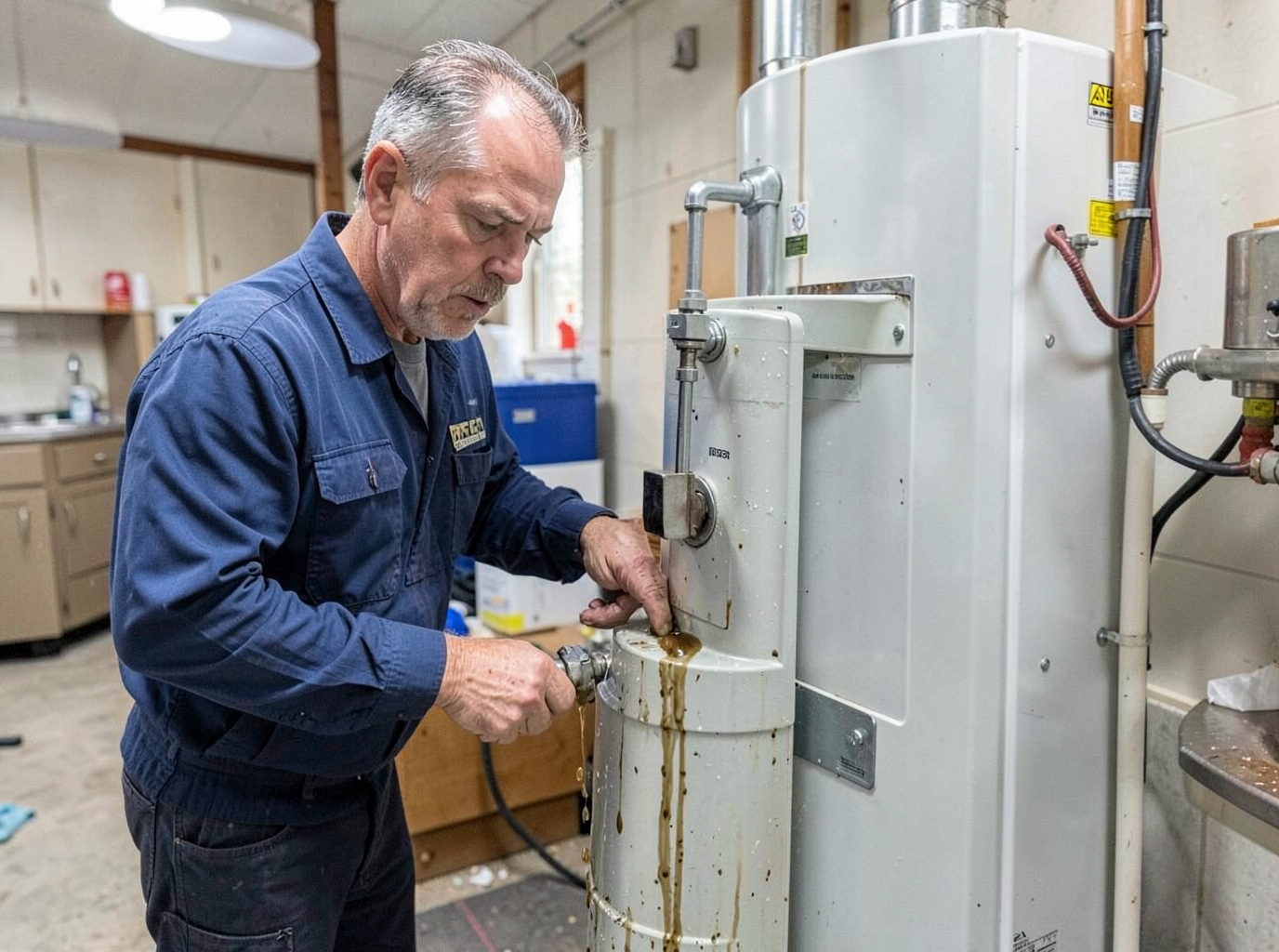
Homes in the Maple Street Historic District and around the University of West Georgia often feature tanks installed decades ago that now show seam or valve leaks after repeated hot summers. Humid subtropical conditions speed exterior corrosion on older units, especially where mild winters allow condensation to linger inside cabinets. Technicians check anode rod condition first because depleted rods let rust advance quickly in Carroll County water with its moderate mineral load.
When leaks appear near the top or bottom of the tank, the job usually involves isolating the unit, draining to a safe level, and replacing gaskets or the entire tank depending on age and access. In two-story homes common near the Historic Downtown Square, extra time goes into routing new lines through tight crawl spaces without disturbing original flooring. Gas models require extra shutoff verification to meet local venting rules before any restart.
Edge cases include leaks that track along the floor and reach nearby electrical panels in basements common in the University of West Georgia area. Technicians always test pressure relief valves during the visit because a stuck valve can turn a small drip into sudden flooding once temperatures swing. Replacement units are sized to match existing connections so permits stay straightforward for Carrollton addresses.
After the fix, a final pressure test confirms no hidden drips at the cold inlet or expansion tank. Homeowners in neighborhoods like Downtown Carrollton receive guidance on flushing schedules that match the local water hardness to slow future corrosion.
Technician insight
In Carrollton, the thing that catches most people out with Water Heater Leaking is how quickly high summer humidity rusts the bottom seam on tanks in pre-1980 homes around the Maple Street Historic District once the anode rod is spent.
Downtown Carrollton Tank Leak
A homeowner near the Historic Downtown Square noticed water under the utility room door after a stretch of humid days. Inspection showed corrosion at the lower seam of a 22-year-old unit. The tank was replaced with a correctly sized model and the area was dried and tested before the crew left.
Water Heater Leaking Services We Offer
✓Tank Leak Assessment
Full inspection of seams, valves, and anode condition to pinpoint the source before any repair begins.
✓Top Valve Leak Repair
Replacement of temperature pressure relief or inlet valves that commonly weep in older Carrollton units.
✓Bottom Drain Leak Fix
Resealing or replacing the drain valve and gasket to stop steady drips without full tank replacement.
✓Seam Leak Evaluation
Assessment of tank wall corrosion common after years in humid Carroll County conditions, with replacement options if needed.
✓Expansion Tank Leak Service
Inspection and repair of auxiliary tanks that fail and send water across utility rooms in local homes.
Water Heater Leaking Cost in Carrollton, GA
| Service | Typical Range | What Affects It |
|---|---|---|
| Valve or gasket repair | $180–$380 | Higher when access requires moving stored items in tight utility rooms. |
| Expansion tank replacement | $250–$450 | Varies with model match and mounting location. |
| Full tank replacement for leaking unit | $900–$1,600 | Driven by tank size, gas versus electric, and any needed venting adjustments. |
| Leak assessment visit | $95–$150 | Credited toward repair if work proceeds same day. |
Ranges are typical for Carrollton, GA and confirmed with an exact written quote before any work starts.
How it works
- 1
Initial Inspection
Technician arrives at the Carrollton address and checks for active leaks, corrosion signs, and unit age.
- 2
Diagnosis
Pressure tests and visual checks identify whether the leak is at a valve, seam, or fitting.
- 3
Repair or Replacement Decision
Parts are replaced on site when possible; full tank swap is recommended only when corrosion has advanced.
- 4
Testing and Cleanup
System is repressurized, checked for drips, and the work area is left dry before departure.
Pricing
Cost depends on whether a simple valve swap or full tank replacement is required and on access in older homes.